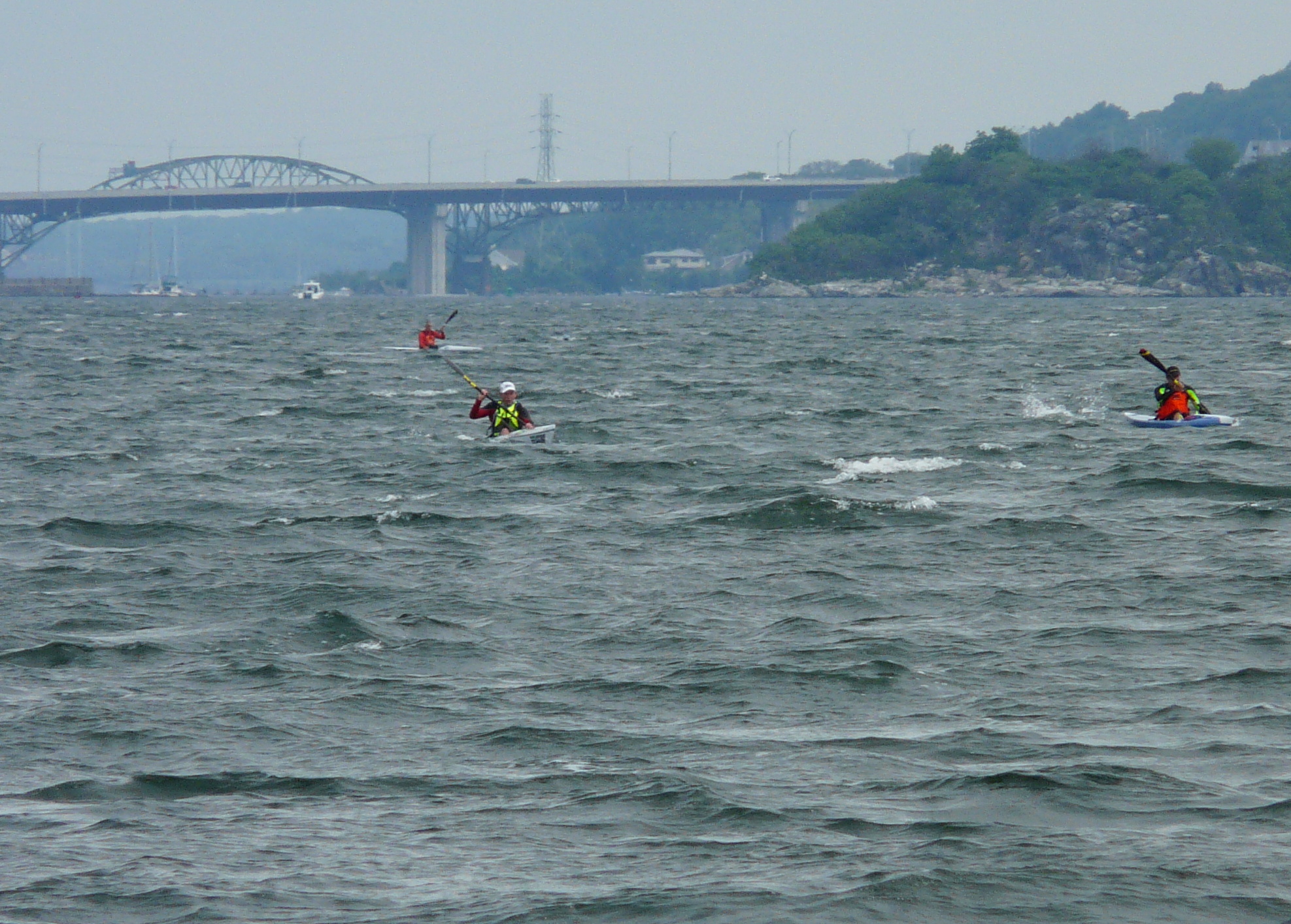
The boat wants to go somewhere else. Not dramatically, not in a way that threatens to capsize, but persistently, with a kind of patient insistence. The wind is coming from the left at maybe thirty degrees off the beam. The mark is ahead and to the right. Every few strokes the bow begins to slip toward the wind source, a gentle rotation that amounts to nothing on its own and everything if left alone.
So you correct. A heavier stroke on the windward side, or a subtle rudder adjustment, or both. The bow comes back. Four strokes later it starts to drift again. You correct again.
In a headwind, the resistance is at least predictable. You lean into it and it stays where it is. In a downwind run, the energy is variable but eventually useful. A run arrives, the boat accelerates, and for a few seconds the work pays a dividend. Crosswind paddling offers neither of these. The lateral pressure simply exists, continuously, without either helping or fighting directly. There is no rhythm to exploit, no moment where the force temporarily works in your favor. It suggests that left is the better direction while you insist on going right, and the negotiation runs for the full length of the leg.
The exhaustion from a long crosswind leg is difficult to explain to someone who hasn’t experienced it. The pace doesn’t look fast. The water is not particularly rough. There are no obvious climbs or surfs. What there is, over and over, is the cost of correction. Each one is small. The paddle’s brief extra load on the upwind side, the half-second where the rudder catches and the boat re-aligns, the micro-brace when a small chop catches the hull slightly sideways. None of these are dramatic. They accumulate without adding up to any single noticeable moment.
Overcorrection compounds the problem. A paddler who fights the drift too aggressively makes the boat swing past center, then corrects back, then past again. The line from above would look like a slow sine wave rather than a straight track. The extra distance is not the main cost; the constant bracing and redirecting is. The body is managing a lateral argument at the same time it is trying to move forward, and those two tasks share a limited budget.
Experienced paddlers in crosswind conditions settle into something that looks like tolerance. The correction comes earlier, when the drift is small, which means it costs less. The rudder is used in brief, quiet interventions rather than sustained steering. The upwind side gets marginally more load without the blade being jammed down hard. The goal is not to eliminate the drift but to keep it in a range where the corrections stay cheap.
Even so, the argument doesn’t end. It runs from the first stroke to the mark, at whatever price the conditions set. The paddler who does best in crosswind racing is not the one who solves the problem. It is the one who finds a way to pay less per repetition, across every repetition, for the full length of the leg.