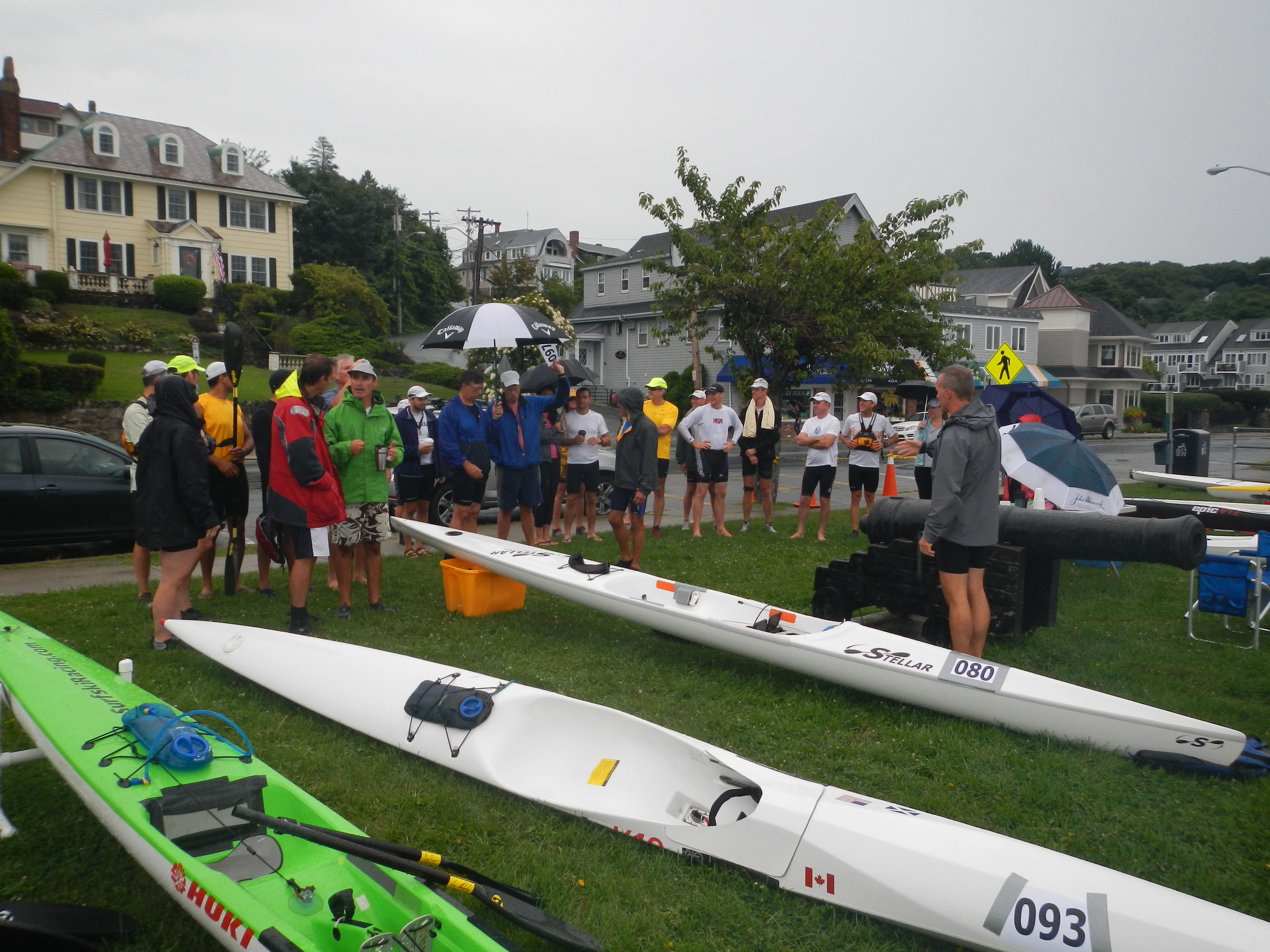
There are paddlers in the launch area you’ve never raced before. Names you’ve seen in results from the other coast, or heard mentioned by someone who trains differently, in water you’ve never paddled. They’re rigging boats thirty feet away. This is the part of Nationals that has no equivalent at a regional event.
You can prepare for conditions. You can study the course, review the tide charts, watch video of the venue. What you can’t prepare away is not knowing how you fit in a field this size. That’s not a problem to be solved. It’s what Nationals actually is.
The uncertainty on a Nationals race morning runs in several directions at once. There’s the weather, same as any ocean race. There’s the water, which may be different from what you train on, in ways that won’t be fully legible until you’re moving through it. And there’s the field itself: athletes from different regions, different backgrounds, different water, who have been developing under conditions that shaped them differently than conditions shaped you. The finish order is an open question in a way it isn’t at an event where most of the field is already known.
A paddler who regularly wins regional races arrives at Nationals holding a result that means something locally and an open question about what it means here. That gap between known performance and unknown standing is the specific texture of the event. Not every race asks it.
In the hour before the start, that question is still unanswered. You’re watching the water, reading how the swells are moving, making the pre-race calculations you’d make anywhere. But you’re also watching the field assemble, and you’re not sure what you’re looking at. Paddlers who’ve raced Nationals before carry previous finishes as reference. First-timers don’t have that. The uncertainty is different for each, but neither group resolves it before the gun goes off.
This is part of why the result holds afterward. The finish time at a regional event lands in a familiar context. You know most of the people around you in the results. You can calibrate quickly. A Nationals finish takes longer to absorb because the context was larger and less familiar. The same performance means something different when the field is this broad.
Shared uncertainty doesn’t just mean that everyone is guessing about the weather. It means the whole field is moving into something none of them have fully accounted for: competitors whose capabilities are mostly unknown, water that may or may not cooperate, a single day that will either confirm or complicate what the previous months of training suggested was possible. The elite paddlers face a version of this. So does everyone behind them.
There’s a particular quality to the start of a Nationals race, in the moments before the field spreads out. The density of the lineup, the breadth of who’s in it, the awareness that this particular convergence happens once a year. The uncertainty is collective and specific. What happens in the next two hours will tell each paddler something they couldn’t have known before they got in the water.