Editors Note: 2026 Nationals is hosted in collaboration with the Blackburn Challenge. Register today at capeannrowingclub.com!
Every edition of Nationals is a distinct test, shaped by its own water, its own wind, its own current. No two competitions are the same, even at the same venue. One year the wind could be light and the water glassy, forcing the pack to grind and jockey for position all they way to the finish line. Another year a squall might surprise the fleet mid-race and change the entire dynamic. It’s a rarity when an ocean course throws no challenges to competitors, aside from distance.
The fact is when ocean racing conditions are demanding, they’re demanding for everyone on the course: athletes competing for the national title, aspirants aiming to crack the top ten for the first time, veterans who have been at this for two decades. The ocean doesn’t care that it’s “Nationals” — it doesn’t care about anything, in fact. There’s no regard for category or ambition. This is what gives your result its weight.
Competitive paddlers typically arrive at Nationals with months of preparation in their tanks. They have trained in wind, chop, flat, cold, heat, and more, often during early-morning sessions when motivation is thin, and in windows squeezed between life’s other commitments. All that time and effort converges onto whatever the ocean decides to do that day. Preparation shapes capacity. Conditions shape the challenge. On race day, the gap between these two becomes clear to each athlete.
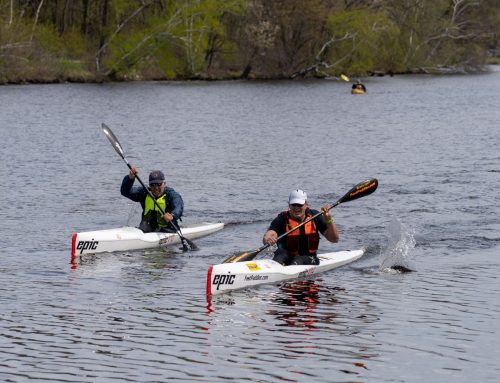
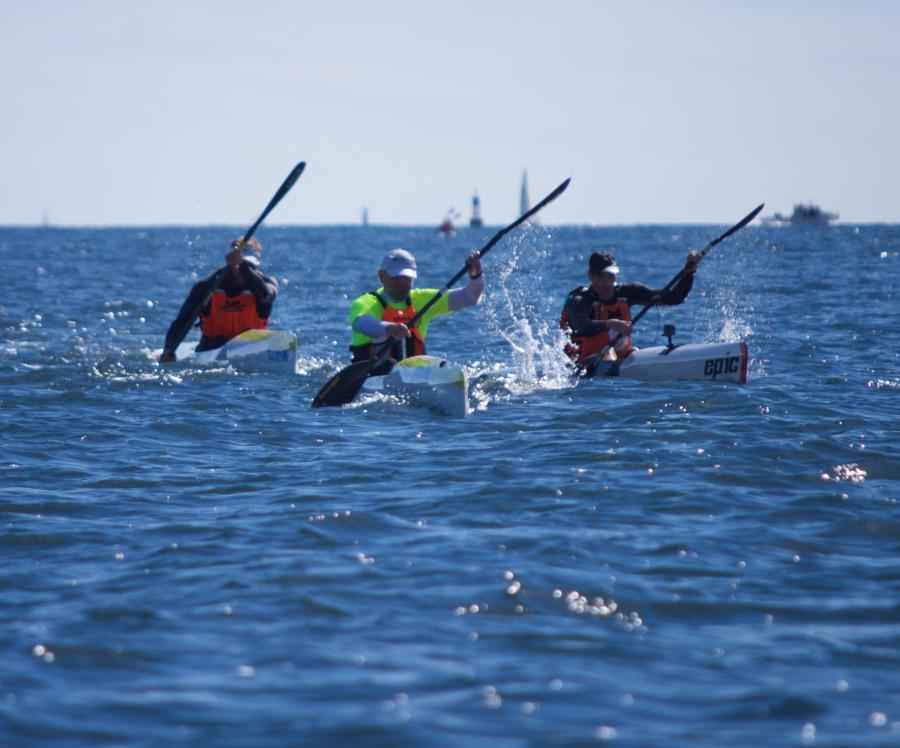
There is something specific about sitting in a Nationals start lineup when the conditions are building. The forecast called for manageable chop. The chop has not read the forecast. There might be a hundred boats in the water, many with no experience paddling the venue aside from a few race week training sessions. Home court advantage isn’t always an advantage, however — at least not physically. Whatever the water offers that day, it offers to all participants equally, although some may find the conditions more…familiar…than others.
A national title won in challenging conditions carries those conditions not just in the result, but potentially for years. Potentially forever. The gap between the first place finisher and the rest of the fleet can be significant, and as a community we celebrate their victory together. Because the water we all raced through was the same. The struggle we were all faced with was the same. Someone will inevitably win the race, most of us will finish the race, and all of us will experience the race.
This is the nature of an open test — a challenge we’re all able to experience, together.