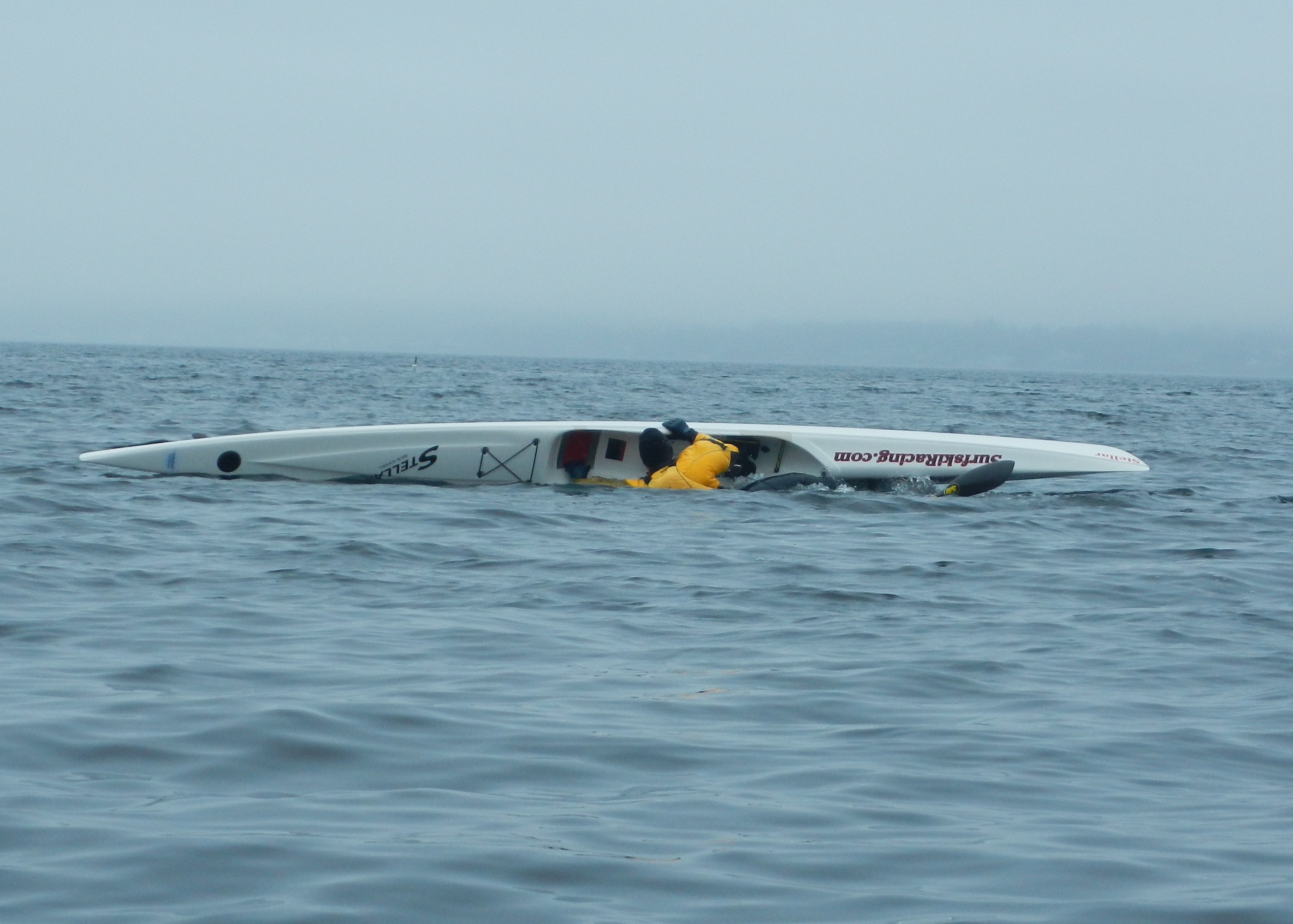
“I’m a good swimmer, I’ll be fine.”
The boat is five feet away, then ten, then fifteen. The hull is above the water, catching air, rolling with the waves. You are floating in the water, catching nothing. The distance continues to increase. You can’t reach it. Even without your PFD and paddle, you’ll never swim fast enough reach it.
In the moment after a capsize, maintaining connection with your ski is critical. The chop can be minimal, the swell can be small, and the wind can be light, but nothing needs to be significant to whisk your boat away. What was momentarily within grasp becomes less so, and then less so again, as the gap between you and the boat acquires its own momentum.
The same conditions that make capsizes more common are, not coincidentally, the conditions that make separation most consequential. A paddler who comes off in significant water has a narrow window before the gap becomes real work to close, and that window compresses extremely quickly. Most will agree that leashes aren’t optional in these scenarios.
The less obvious danger is calmer water, good visibility, easy re-entry: conditions where it seems nothing could go wrong. Those are the sessions where paddlers leave the leash behind, and where a small unexpected factor, a boat wake, a moment of inattention, an awkward shift of weight, turns a routine capsize into a potentially life-changing situation.
Swimming to retrieve a boat is not a neutral action regardless of the conditions. A PFD keeps a swimmer afloat but works against efficient movement: it creates significant drag, restricts arm extension, and sits high on the torso in a way that alters your ability to move efficiently through the water. Carrying a paddle while swimming compounds the problem. With a paddle in-hand, you are forced to perform a side-stroke, which can be exhausting. Even when it can be secured to your life jacket, presuming you’ve practiced this skill and have developed a workable mechanism for securing it, a paddle changes the swimmer’s profile in the water and introduces additional drag, when very likely you’re already feeling a bit spent.
This is the problem the leash solves. Not by making capsizes less likely, but by keeping the boat where you are. Near shore, a boat drifting five meters might result in an inconvenient slog to the beach in order to collect your ski. Offshore, that same separation is an entirely different kind of problem.
Your boat is your mechanism of return. It is the tool that enables you to arrive home safely. You cannot, must not, become separated from your ski.
Always wear your leash.