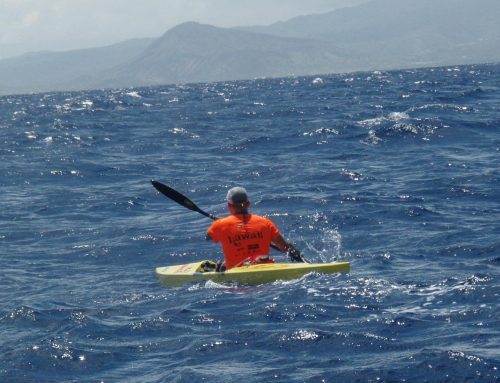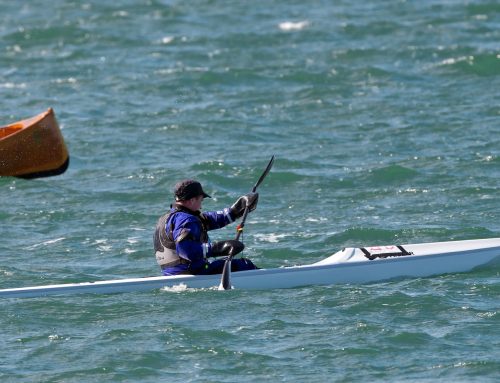
A runner lifts behind you, and for half a second you know exactly what to do. Then the half second passes, and you’re still thinking about it. The gap between the boat and the swell has changed by the time you finally push, and what would have been a clean connection turns into a paddle stroke buried in foam. Nothing about the wave was difficult. The only thing that failed was the timing of your own decision.
That gap between reading a lift and committing to it isn’t fixed, and it isn’t something you’re simply born with either. It’s a reflex, and like other reflexes in this arc, it responds to how much you’ve asked of it, not to how hard you concentrate on any single wave. Two paddlers can feel the same swell build behind them and still end up in different places, because one has spent enough sessions closing that gap that acceleration and recognition arrive together, while the other is still running the two as separate steps.
Commit to a lift that turns out smaller than it felt, and you find out within a few strokes. The push comes up short, the boat settles back rather than surging, and you’re paddling flat water again almost immediately. That costs very little, because you were already accelerating when the answer arrived. Hesitate on that same lift instead, waiting to be sure, and something different happens even if you eventually judge correctly that it wasn’t going to run. The checking itself has a cost, paid in strokes not spent accelerating, and being right that the lift wasn’t worth it doesn’t refund them.
That asymmetry is the whole point, and it’s also the reason this is a skill worth training rather than just understanding. A committed decision that turns out wrong costs a few wasted strokes. A hesitant decision, even one that turns out to have been the correct read, costs the same delay every time, win or lose. Knowing that doesn’t close the gap by itself. Only enough repetitions of feeling a lift and committing to it, over and over, in conditions low enough stakes to notice the hesitation itself rather than just its outcome, actually shortens the distance between the two.
A calm, small-swell session spent committing to every marginal lift, with nothing riding on whether each one turns into anything, does more for that gap than a season of races where every choice carries consequence. Low stakes are what let the checking become visible as its own separate cost, worth training away on purpose instead of just living with.
This is what enough of those sessions eventually produce: paddlers who commit to nearly every lift they can reach on a real run, not because they’re reading the swell better than everyone else, but because the asymmetry has been drilled into something automatic rather than reasoned through each time. What looks from shore like recklessness is training, run enough times that hesitation no longer gets a vote.
Early in that process the gap is long enough to notice, a window closing while you’re still aware you haven’t moved through it. Session after easy session it tightens, until feeling the swell and accelerating into it arrive as the same motion. You notice the shift back on a real run, catching pieces you would have watched go by a season earlier, not because you got better at guessing, but because the training closed a gap that used to be decided one wave at a time.