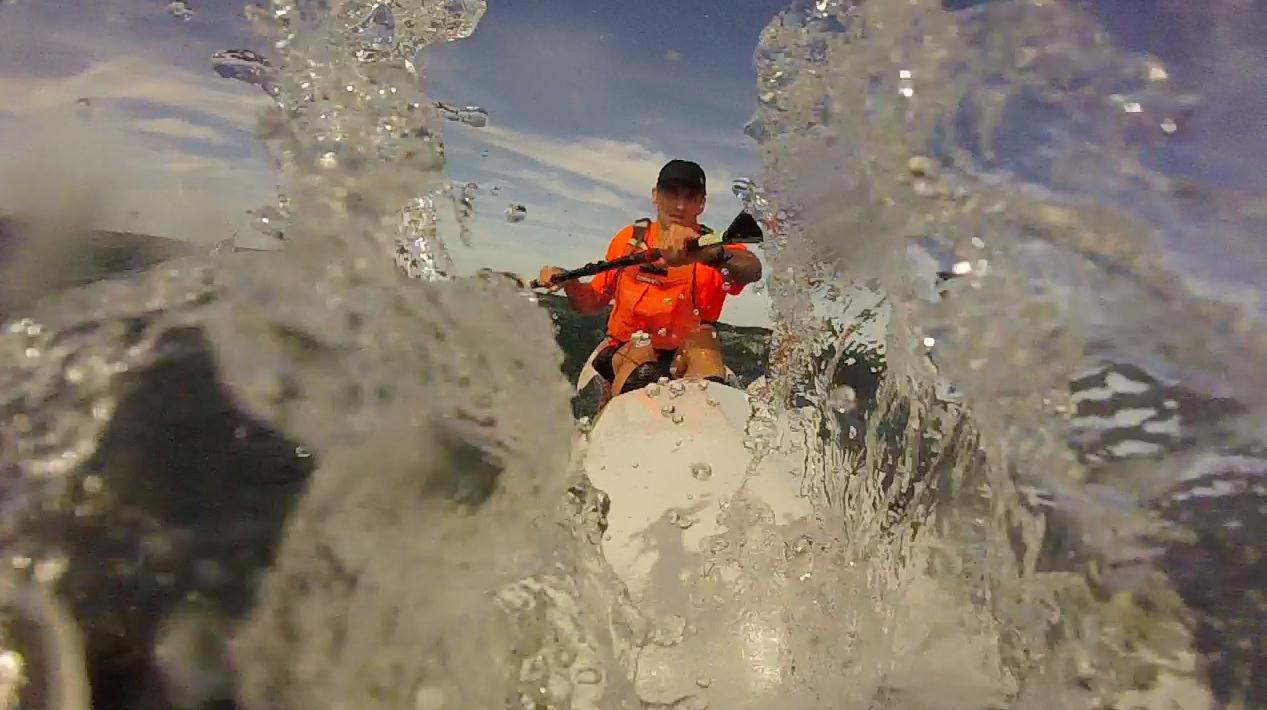
Many paddlers approach downwind paddling with an endurance mindset. The goal is to hold a strong pace, keep pressure on the footboard, and trust that consistent effort will translate into consistent speed. That approach works well on flat water, and it feels reassuring in rough conditions where backing off seems risky. Yet downwind, sustained power often leads to fatigue without the payoff it promises.
If you watch how the boat actually responds offshore, you start to notice that speed changes happen in short windows. A brief increase in pressure under the hull allows the ski to lift and run, but only if the paddler meets that moment with acceleration. Long stretches of steady effort do little to prevent the boat from settling back into drag once the energy passes. The ocean is offering help intermittently, not continuously.
Paddlers who move efficiently downwind tend to match this pattern. Instead of trying to push the boat all the time, they apply power in short bursts, often before the water in front of them looks especially helpful. These accelerations are not sprints in the traditional sense. They are quick investments of effort meant to bring the hull up to speed so that incoming energy can do more of the work. Once the connection is made, the paddler can ease slightly and let momentum carry forward.
This explains why downwind speed can feel surprisingly relaxed even when the boat is moving quickly. The effort is real, but it is concentrated in moments rather than spread evenly. It also explains why paddlers who rely on constant pressure often feel busy and tired. They are spending energy during periods when the ocean is not offering much in return, and then scrambling to accelerate when it finally does.
Rather than asking how hard you should be paddling, it can be more useful to ask when it is worth paddling harder. That shift in focus encourages attentiveness to timing instead of commitment to a fixed output. In the next article, we will look at how this stop-and-start nature of downwind speed complicates the way we interpret GPS data, and why many paddlers misunderstand what their numbers are actually telling them.