Introduction
On February 2, I kicked off my “on season” training plan for the upcoming year that I look forward to every year. That was delayed three weeks later due to the flu, not the coronavirus. I did get my flu shot but with only 45% efficacy due to a different flu strain, I managed to get it. With all that said, I really began thinking about the 2020 race season a few weeks before the 2019 East Coast Surfski Championships (L2L) in September.
I have been paddling surf skis since 2003 and started reviewing them in 2010. I have many training miles, racing miles, and have taken and given many lessons. During this time, I have personally sold many surfskis and been responsible in part for the sales of many more. In other words, I am a little long in the tooth. I am still competitive at most races that include running, surfskis or indoor rowing. So with many miles on my paddle, I have changed up a few things as I have gotten older from training to a selection of skis for different races.
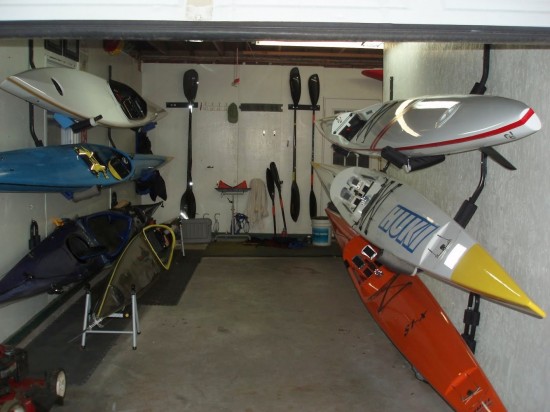
One of the 10 questions I ask all paddlers when purchasing a ski is, how old are they? Older paddlers need more stability or at the very least will enjoy being in more stable skis especially in ocean conditions. I am no different. So two weeks before the East Coast Championships I bought back one of my 2009 Stellar SEL’s 1G. The benchmark for many paddlers is 2 hours or below for this race. My boat of choice was the SEL 1G with a modified 6-inch rudder.
So in this Post I will highlight the Stellar surfskis that I have reviewed over the past few years. In another post or an addition to this post, I will review the other brands or skis.: Think, Nelo, Epic, Swordfish.
Stellar SEL 1G Excel
Why an old design ski for one of the most competitive races on the East Coast? Currently, I still view it as the best speed to stability ratio of any surfski. I clocked a 2:00:44 and felt pretty good the whole race. Goal accomplished! In the last few years, I paddled my Ions, however, I always got a little boat fatigue in the later parts of the race, ie getting older!
The SEL 1G was designed with less rocker that makes them faster though less maneuverable. Due to the less rocker, it can accommodate any size rudder to maximize speed without sacrificing too much stability. It is easy to remount and is a medium volume ski. Seating is outdated by today’s standard, but fairly comfortable despite the hump placed too far aft for short paddlers like me. It has too much open area forward of the footplate but that has never affected my performance except once at Sakonnet River Race when I chose an SEL 1G advantage (30lbs) vice Excel. Paddling upwind/against the current in a gale, it would not drain fast enough at my pace. Due to the lack of rocker and rudder placement, steering is adequate. It tracks nicely though downwind, just don’t expect to maneuver on/off waves like more rockered skis. I have had some of my best races in this model ski. I expect to be in it for a number of races this year too. I have said many times, update the seating and keep the hull the same and Stellar would have another successful model. No longer in production, since the 2015 SEL 2G replaced it. See below.
Stellar SEL 2G
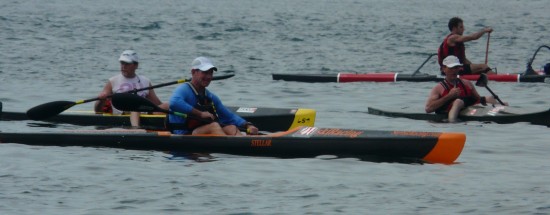
I raced this version for several years and was the first to review it. Last year at the East Coast Champs I bought this model after not paddling it for a number of years. I wanted a ski that was more stable in the advanced class and I wanted to compare it again to the SEL 1G. When I originally reviewed it, in retrospect, I rated it too fast compared to some of the advanced skis.
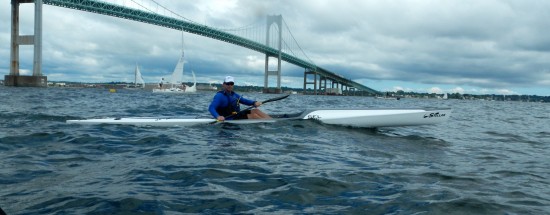
An interesting fact about this ski is that it needs to be trimmed correctly by adjusting the footplate perfectly. If not trimmed correctly, the bow will flop around upwind creating instability. When I reviewed this ski originally, I did have it trimmed correctly so I never thought this was an issue for the years I raced it in New England conditions. However, I paddled it upwind the day after the East Coast champs in 1.5 ft seas and I had a different experience than I remembered.
So I adjusted the footplate back and forth for a few training paddles to sort this out. So every paddler may not be able to enjoy this ski. However, once trimmed correctly, I enjoy paddling this ski as I did for a couple of years.
What I like about it is the stability in flat to moderate conditions and my ability to remount it even in big conditions. Having said that, in confused conditions, it becomes less predictable and requires advanced boat skills. So it is not my big water ski. Also downwind, in small to moderate conditions, I describe it as loose, not the best tracking ski, so you have to get used to this.
Despite all this, it is my “go-to” on the Sakonnet where I live which is predominantly small bay conditions. So in summary: Good stability, Good speed, great construction, easy to remount, lower volume ski, and more relaxed cockpit than my Thinks and this one has the venturi’s and not a bailer which I prefer in all skis!
Stellar SEI 2G 2019 version
My most recent purchase (December 2019) is the lastest SEI 2G complete with side handles, and a bailer. After racing my Evo 3G for a few years and comparing the SEI, Evo and Nelo 550 back to back in a review, I decided for I needed a more stable ski for certain New England ocean races: Blackburn, Ride the Bull, Paddle the Bay, Double Beaver. The SEI 2G is very familiar to me having raced it for years in all conditions.
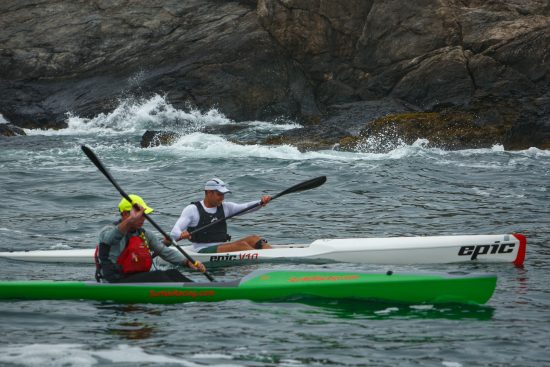
In my prime, I paddled my SES 1G for many of these races with some of my fastest times ever. Those days are long gone. Fortunately, we have so many great choices in the intermediate class of skis. I raced the SEI 2G in many of these races above with success.
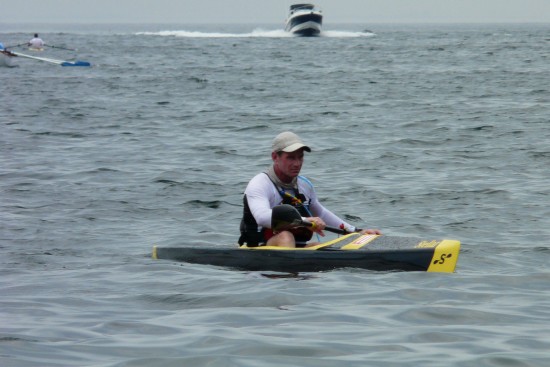
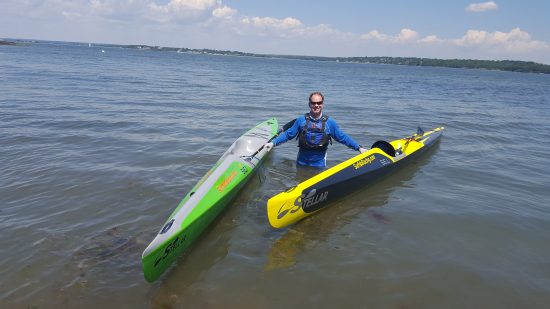
What I have always liked about the SEI 2G is the excellent glide, lower volume, easy remounting, the ability to scaled down to a 6-inch rudder without affecting the stability too much, its top line construction and of course, it’s predictable stability in all conditions. The SEI 2G is a superb all-around for all conditions.
I rate the stability of the intermediates skis in this order from most to least: SR 2G, V10 Sport, Swordfish, SEI 2G, Evo 3G, 550. As I tell paddlers that I give lessons too, the small details matter in surfski paddling. So in this case, the extra stability the SEI 2G affords me over my Evo’s is apparent to me now as I age. While the bucket is not as ergonomic as my Evo’s, I need the extra stability.
Stellar SR 2G
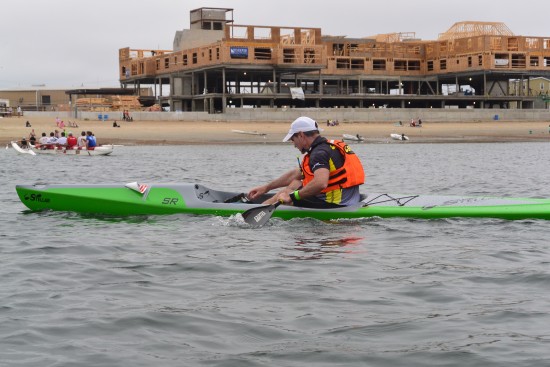
Some of my most memorable paddles have been in my SR. I paddled my SR with a 4-inch rudder in 30 mph winds against the current under the Newport Bridge in turbulent waters wonder if I was going to crash into the concrete abutment. I did not. I have that on video! Another example is racing my SR in the 2015 Blackburn where half the field did not finish due to 4-6ft seas. What does this say about the SR? It is a wonderful big water ski that is easy to remount, has very competitive speed, fits virtually everyone, and is a great choice for an all-around ski. You can change the rudder out for different conditions or add a DK rudder for better pure surfing. This is my go-to boat for big conditions in Narragansett where I want more stability than the SEI affords.
S18S 2G
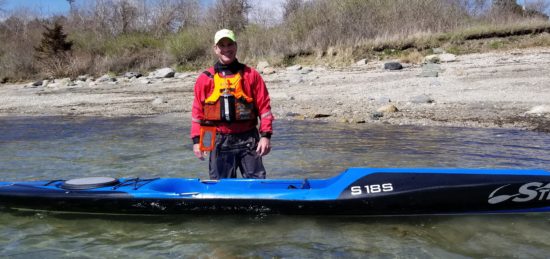
This latest version of the S18S increased the speed over the 1G, updated the bucket with a narrower bucket and better paddling ergonomics. Like most Stellars, the glide is noticeable along with its stability. My first paddle in S18S 2G was out to the Beavertail Can in 3ft seas in my drysuit. It handled these conditions with no problem though the ride was wet with the low gunwales where the side handles are. I time trialed this ski on a perfect day and was shocked how fast I was able to paddle it. Another time trial proved more representative of its speed but never the less, I was impressed with its speed.
SEA
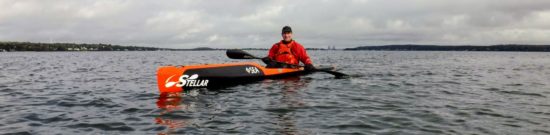
I really enjoyed paddling my SEA and had some real reservations about selling it. It has the best seating position of any Stellar with excellent ergonomics with a relaxed fit that I enjoyed. It has good glide, tracks upwind and downwind very nicely with limited side to side movement and turns on a dime. I put a shorter rudder on it too, with little difference in stability due to a more forward rudder placement. However, as part of getting older, I am more aware of remounting. The SEA takes more effort to remount with a deeper bucket and higher gunwales similarly to the Fenn skis in this regard. So for me taking it out would be limited to flat water or summer days with very moderate conditions. Remember I am in a drysuit for 6 months of the year. When I time trialed it against my Ions, it did not pick up the bumps as I was hoping it would and required more effort to get on a run and hold it. I called the SEA my cruising ski, since it was so comfortable to paddle, and I loved the rounded for deck.
SES 2G
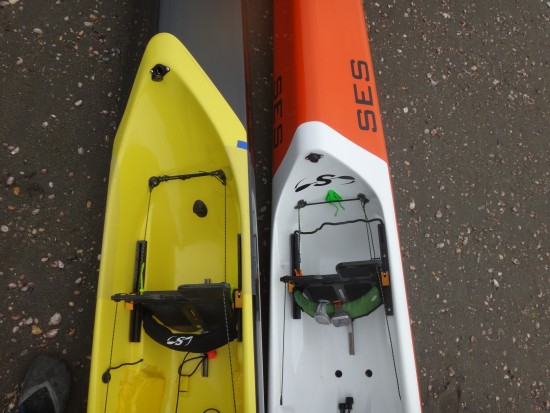
While I love my SES 1G, that would skip over the waves at record times for me. This SES 1G ski was really a mid-volume ski designed for the smaller to mid-size paddler, while the 2G was scaled down in volume and bucket and was less stable. I had limited racing success due to I was over the optimal weight limit when I weighed in at 175. The other reason was I never got used to the stability in bigger conditions similar to my Uno 2G. I time trialed both back to back one day in conditions and while they have a much different feel, the Uno 2G barely edged out the SES 2G on that day.
Summary
Stellar skis, unlike many other brands, have less rocker are less V’ed which I personally like. The trend over the last few years has been ultra rocker skis to perform in downwind conditions. Here in New England where we have mixed conditioned paddling and have to search out downwind conditions, less rockered skis are my favorite since they can be paddled in the flatter conditions where the speed shines. Stellar, for years, has been the market leader in quality and lightweight skis. They also have a full range of recreational kayaks, sea kayaks, and surfskis for every level of paddler and due to this variety is now one of the leaders in composite kayak sales. They have come a long way since 2009!